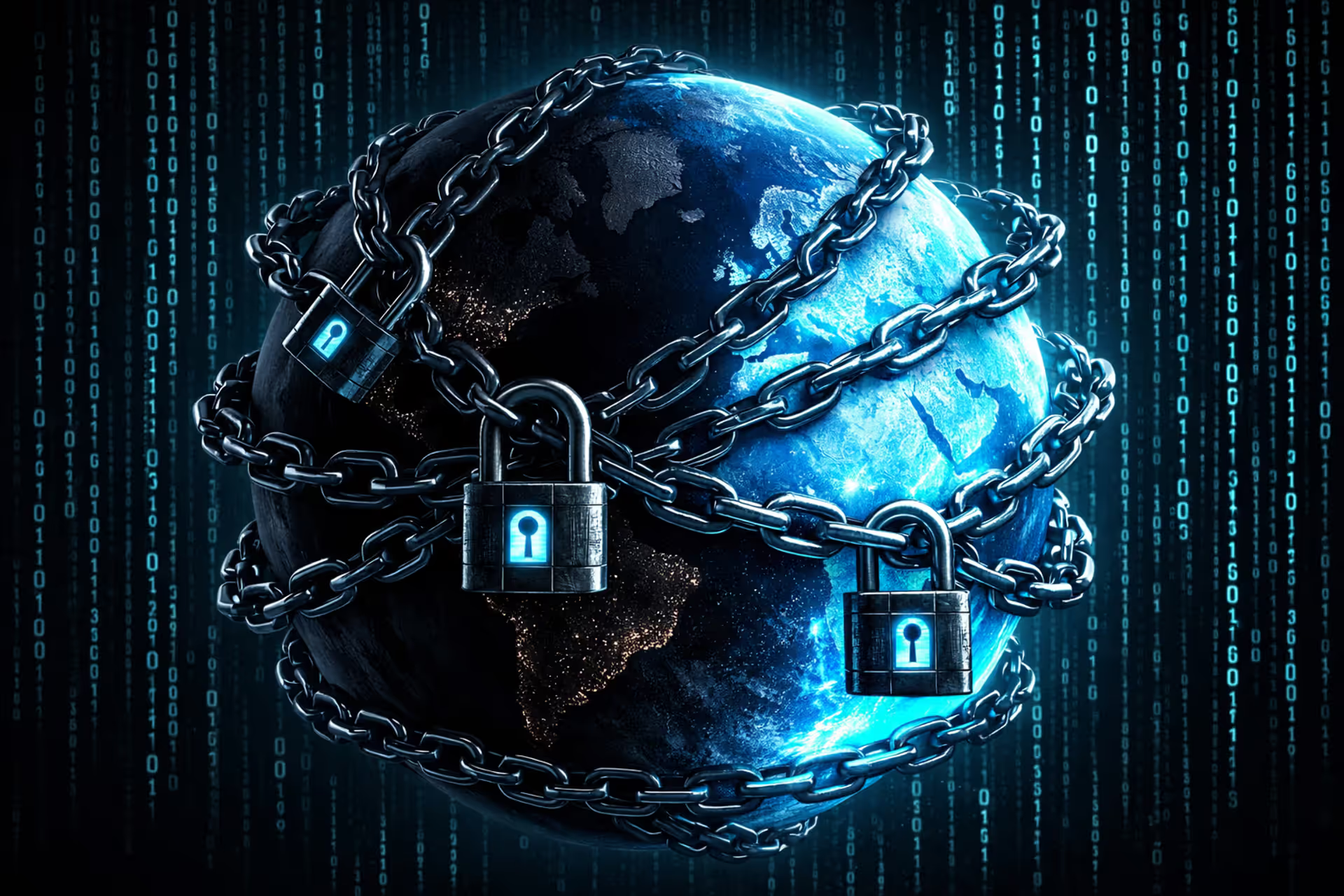
Digital globe wrapped in chains and padlocks with binary code streams, dark regions representing censored internet zones and bright blue areas showing free access
What Is Internet Censorship and How It Works

Content
Think of internet censorship as a government or powerful institution deliberately blocking your access to information online—often without telling you it's happening. You try visiting a news website, and instead of loading, you get an error message. Or maybe it loads, but certain articles are missing. That's censorship at work.
Here's what separates censorship from regular content decisions: force and secrecy. When Netflix removes a show due to licensing issues, they announce it. When Facebook deletes a post for violating rules you agreed to, you typically get notified. Censorship? Someone with authority—usually a government—blocks content you're trying to reach, and they'd prefer you didn't know why or who made that decision.
The internet censorship definition covers more ground than just removing webpages. It includes slowing down your connection to specific websites until they're unusable, manipulating search results so certain topics never appear, or preventing journalists from publishing stories critical of those in power. All these tactics share one goal: controlling which information reaches the public.
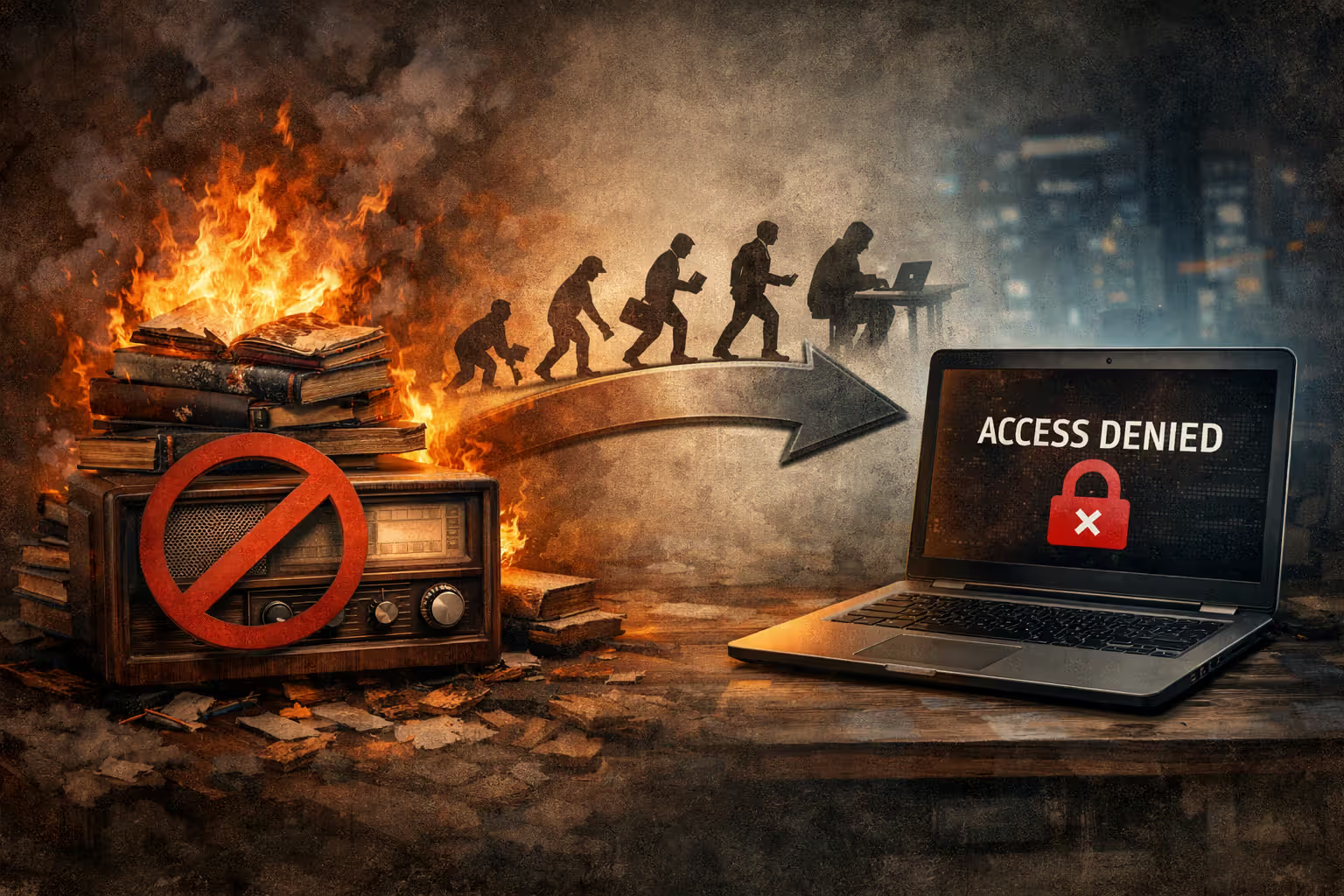
Pre-internet censorship required physical intervention. Stalin airbrushed political enemies from photographs. Nazi Germany held book burnings. Military juntas shut down printing presses and radio stations. Controlling information meant controlling the physical infrastructure that distributed it.
The internet looked different initially. Its creators at DARPA designed a network that could survive nuclear attacks by routing data through multiple paths. If one connection failed, packets would find another route. This architecture made many technologists and activists optimistic in the 1990s—surely such a resilient, decentralized system couldn't be controlled by any single government.
Author: Lindsey Hartwell;
Source: flexstarsolutions.com
They were wrong.
By 1998, China had begun building what would become the world's most sophisticated censorship infrastructure, initially called the Golden Shield Project. Western observers nicknamed it the Great Firewall—a play on China's famous historical barrier, except this one kept ideas out instead of invaders. Countries like Iran, Vietnam, and Saudi Arabia watched and built their own versions. Even democratic governments started blocking websites, initially targeting child exploitation networks but gradually expanding their scope.
So what qualifies as censorship versus reasonable content control? Intent and process matter here. Copyright enforcement follows established legal procedures with appeals. Removing terrorist recruitment videos happens transparently under laws passed by elected legislatures. These involve content restrictions, yes, but they come with public justification, clear legal standards, and ways to challenge incorrect decisions.
Censorship operates in the shadows. It's political rather than legal. It targets ideas and viewpoints rather than specific illegal content. And it rarely offers any appeal process—bureaucrats or automated systems make decisions that citizens can't effectively challenge.
Types of censorship online span an enormous range. Some governments surgically remove individual social media posts that mock leaders. Others shut down the entire internet during elections to prevent opposition organizing. The technical methods vary too: basic systems use simple website blocking that tech-savvy users easily bypass, while advanced systems employ real-time traffic analysis that defeats even sophisticated circumvention tools.
Government Censorship vs. ISP Blocking: Who Controls What You See?
Knowing who's actually blocking content helps you understand how to regain access—and who to hold accountable.
Government-mandated censorship works through laws forcing internet providers, search engines, and platforms to restrict what users can access. Russia's Roskomnadzor (their internet oversight agency) maintains a federal registry of banned sites that all ISPs must block—currently listing over 170,000 entries. Turkey's Law 5651 lets courts order website blocks for vaguely-defined "threats to national security," which has meant blocking YouTube for years. China's 2017 Cybersecurity Law requires any company operating there to store user data on Chinese servers and cooperate fully with censorship requests—no warrants needed.
National firewall systems represent the ultimate expression of government control. China's doesn't just maintain a list of blocked sites. It monitors internet traffic flowing across China's borders in real-time, looking for forbidden content. Type "Tiananmen Square massacre" in a message, and the system automatically cuts your connection. It learns from circumvention attempts, identifying new VPN protocols within hours and blocking them across the entire country.
ISP-level blocking is how these government orders actually get enforced technically. Your internet service provider controls the network equipment between your computer and the broader internet—routers, DNS servers, fiber optic cables. This infrastructure gives them multiple points where they can intercept and block traffic. Some ISPs implement government blocking orders reluctantly, viewing themselves as neutral conduits being forced to censor. Others cooperate enthusiastically with authorities.
Private platform decisions occupy entirely different territory. When YouTube removes a video for hate speech or Twitter suspends an account spreading election misinformation, they're enforcing rules on their own property. You signed their terms of service when creating your account. Don't like their policies? Use a different platform. That's marketplace competition, not censorship.
Except the lines get blurry fast. What happens when government officials threaten social media executives with arrest unless they remove posts criticizing the government? That happened in India during 2021, when officials demanded Twitter block dozens of accounts critical of the government's COVID-19 response. Twitter employees faced potential criminal charges. The company eventually complied. Was that Twitter enforcing its terms of service, or the Indian government censoring through intimidation?
Both, really. That's why context matters so much.
| What We're Comparing | Government Orders & Laws | ISP Implementation | Platform Rules & Policies |
| Who Has Authority | Courts, legislators, executive agencies issuing mandates | Government orders they must obey OR voluntary corporate policies | Company executives applying their own terms of service |
| Technical Implementation | Depends entirely on ISPs/platforms to carry out | DNS manipulation, IP address blocks, inspecting actual data packets | Deleting posts, suspending accounts, demoting content in feeds |
| What Can Users Do | Court challenges if independent judiciary exists; international advocacy campaigns | Change to different ISP if options exist; use technical workarounds | Appeal to platform support; move to competitors |
| How Open Is The Process | Authoritarian states hide everything; democracies sometimes publish block lists | Usually hidden; users learn sites are blocked by trying to visit them | Getting better; Meta, Google publish regular reports on takedowns |
| Real Examples | China's comprehensive firewall, Iran's filtering infrastructure, Russia's Roskomnadzor blacklist | UK mandates ISP blocking for certain content, Australia's site blocking, US court-ordered blocks (rare) | Meta's Oversight Board decisions, YouTube's content policies, Twitter/X's changing moderation under Musk |
How Internet Censorship Actually Works: Technical Methods Explained
DNS tampering is the most common blocking technique because it's cheap and easy. Here's how it works: When you enter a website name like "blockedsite.com" in your browser, your computer needs to convert that human-friendly name into a numeric IP address (like 93.184.216.34) that computers actually use. Your device asks a DNS server—essentially the internet's phone book—to look up this address.
Censors control DNS servers. Instead of giving you the real IP address, the controlled DNS server lies. It either returns an error ("this site doesn't exist") or redirects you to a government warning page. The website isn't actually down—you're just being prevented from finding it.
The weakness? You can use different DNS servers. Switching to Google's public DNS (8.8.8.8) or Cloudflare's (1.1.1.1) bypasses government DNS servers entirely. That's why sophisticated censors need additional tools.
IP blocking targets the numeric addresses themselves. Even when you know a website's actual IP address, the routers your internet provider controls can simply refuse to forward your traffic there. Network equipment recognizes the destination IP and drops your connection requests. This works better than DNS manipulation, though it creates problems: many websites share IP addresses through cloud hosting services, so blocking one site often accidentally blocks hundreds of innocent ones sharing that address.
Deep packet inspection gets seriously invasive. DPI equipment doesn't just look at where your traffic is going—it reads the actual content. Specialized hardware installed at internet exchange points examines data packets flowing through, searching for forbidden keywords or recognizing patterns of VPN connections. China's firewall uses DPI extensively, which is why most commercial VPNs don't work there. The system recognizes the distinctive "handshake" when VPN software tries connecting to external servers and immediately blocks it.

Author: Lindsey Hartwell;
Source: flexstarsolutions.com
Keyword filtering scans internet traffic for prohibited words and phrases. The system might watch for terms like "free Tibet" or "opposition party" or specific politicians' names. Detect a forbidden keyword, terminate the connection. In China, this creates strange workarounds—people use homophones, replace characters with similar-looking symbols, or develop coded language everyone understands but algorithms might miss. Until the algorithms learn, anyway.
URL blacklists are exactly what they sound like: massive databases of forbidden web addresses that censors continuously update. China employs thousands of people who do nothing but monitor the internet for new content that should be blocked. They review social media posts, scan news sites, check forums. When they find something objectionable, it gets added to the blacklist within hours—sometimes minutes.
Bandwidth throttling offers a sneakier approach than outright blocking. Rather than preventing access completely, censors slow specific services to unusable speeds. You can technically still reach that news website, but pages take five minutes to load. Videos buffer endlessly. Most users give up, which is exactly the point. This technique looks like technical problems rather than deliberate censorship, giving governments plausible deniability. It's particularly effective against VPNs and circumvention tools—slow them down enough, and they become too frustrating to bother with.
The Difference Between Censorship and Content Moderation
Intent separates these practices. Content moderation aims to keep platforms functional and communities safe—removing spam, stopping harassment, enforcing copyright. Censorship aims to suppress political viewpoints and control narratives.
Transparency matters enormously. Facebook publishes detailed community standards explaining exactly what content they prohibit and why. They release quarterly reports showing how many posts they removed and for what reasons. Google publishes transparency reports detailing government requests for content removal, which requests they complied with, and which they refused. That's moderation done openly.
Censorship hides in darkness. Governments rarely explain why specific sites are blocked. Turkey blocked all of Wikipedia for three years—the official reason kept changing, and the actual blocking order was classified. Citizens had no way to appeal or even understand the justification.
Legal enforcement versus terms-of-service enforcement creates another crucial distinction. Break YouTube's community guidelines, they'll delete your video or suspend your account. That's the extent of their power—exclusion from their service. Circumvent government censorship in China or Vietnam? You risk prison. State power involves police, courts, and prisons. Platform power involves loss of access to their service. Entirely different scales of consequence.
The trickiest situations involve platforms operating across countries with conflicting laws and values. Content criticizing the Thai monarchy is protected speech in America but illegal in Thailand under lèse-majesté laws carrying 15-year prison sentences. Does Facebook remove this content globally? Only in Thailand? Or refuse to operate in Thailand at all? Every choice involves trade-offs between market access, user safety, and free expression principles.
7 Common Examples of Internet Censorship Around the World
Social media blackouts during protests have become the authoritarian playbook's standard opening move. When massive protests erupted across Iran in September 2022 following Mahsa Amini's death in police custody for improperly wearing a hijab, authorities immediately blocked Instagram and WhatsApp—the main platforms Iranians used for coordination and communication. Ethiopia shut down internet access entirely across Tigray region during their 2020 elections. Myanmar's military junta ordered a total internet shutdown following their February 2021 coup, keeping it dark for days while they arrested democracy activists. The pattern repeats because it works: no internet means protesters can't organize large gatherings, can't livestream police violence to international audiences, can't coordinate legal observers or medical volunteers.
News website blocking in authoritarian states systematically eliminates independent journalism. Russia blocked BBC Russian, Voice of America, Radio Free Europe, Meduza, and hundreds of independent outlets after invading Ukraine—anyone reporting casualty figures contradicting official statements faced blocking within hours. China blocks essentially every foreign news organization not subject to government editorial control: The New York Times, Washington Post, The Guardian, Reuters, Bloomberg. Belarus blocked Charter97, Nasha Niva, and major independent news sites after fraudulent 2020 elections sparked massive protests. Governments understand that controlling information flow means controlling political narratives—if citizens only see state-approved news, they're more likely to believe state-approved versions of events.

Author: Lindsey Hartwell;
Source: flexstarsolutions.com
Search engine result manipulation shapes what information citizens can even discover exists. Search Baidu (China's dominant search engine) for "June 4th" or "Tiananmen Square 1989" and you'll find results about weather, tourism, anything except the massacre. "Winnie the Pooh" became sensitive after internet users compared President Xi to the cartoon bear—now heavily filtered. Russia required Yandex to suppress opposition websites, independent media, and protest coordination information. When Google operated in China (2006-2010), they filtered search results to comply with censorship laws, though they eventually withdrew entirely rather than continue cooperating.
Messaging app bans eliminate private communication channels governments can't monitor. Iran banned Telegram and Signal after 2017 protests, forcing citizens toward domestic apps with government backdoors built in. Pakistan blocks Telegram periodically during political unrest. These encrypted messaging services terrify authoritarian governments because they enable organization beyond state surveillance—protesters can coordinate privately, journalists can communicate with sources, activists can plan without revealing their identities to authorities.
Wikipedia restrictions seem almost petty until you consider what they reveal about government insecurity. China blocks Chinese Wikipedia entirely and restricts access to English and other language versions—they can't control the narrative on a platform where anyone can edit and citations are required for claims. Turkey blocked all Wikipedia access for three years (April 2017 to January 2020) because two articles mentioned Turkish government support for Syrian jihadist groups—true information Turkish officials wanted suppressed. These blocks target Wikipedia specifically because encyclopedic entries with sources and edit histories directly contradict official propaganda.
Academic and research content blocking demonstrates how censorship damages more than politics. China blocks Google Scholar, forcing researchers to access international academic databases through cumbersome workarounds. Iran blocks many scientific journal websites. This academic censorship isolates scholars from global knowledge networks, hampering research capacity and technological development. Students writing papers can't access standard reference materials. Scientists can't read the latest research in their fields. The damage accumulates over time as educated populations fall behind international standards.
Political opposition website takedowns systematically eliminate platforms for dissent. Russia blocked Alexei Navalny's website, his Anti-Corruption Foundation site, and associated platforms after his poisoning and imprisonment. Thailand blocks hundreds of websites criticizing the monarchy under strict lèse-majesté laws. Vietnam blocks sites run by political activists, religious groups outside government control, and human rights organizations. These targeted blocks eliminate specific voices challenging government authority—can't read opposition viewpoints if the websites hosting them are unreachable.
Internet shutdowns and social media blackouts have become the new normal for authoritarian regimes facing domestic unrest. We've documented this playbook repeatedly: first they throttle bandwidth making services barely usable, then they block messaging apps so protesters can't coordinate, then they shut down internet entirely if demonstrations persist. It's collective punishment designed to isolate populations and prevent documentation of government abuses reaching the outside world
— Felicia Anthonio
How People Bypass Censorship: Tools and Techniques That Work
VPNs (Virtual Private Networks) work by creating an encrypted tunnel between your device and a server located outside the censored network. All your internet traffic routes through this tunnel—your ISP sees only encrypted data flowing to the VPN server, not which websites you're actually visiting. The websites you visit see requests coming from the VPN server's location, not your real location. This bypasses local censorship because the blocking happens on your local network, which you've effectively exited.
How well VPNs work depends entirely on censorship sophistication. Against basic DNS blocking or simple IP filtering? VPNs work perfectly. Against China's Great Firewall with deep packet inspection? Most commercial VPNs fail. The firewall recognizes VPN connection patterns and blocks them. Some VPN providers fight back with obfuscation—disguising VPN traffic as regular HTTPS web browsing. This becomes an endless technical arms race: censors develop better detection, VPN providers develop better disguises, repeat.
VPNs have real limitations you should understand. You're shifting trust from your ISP to the VPN company—whoever runs the VPN can see everything your ISP previously could. Free VPNs often monetize by selling your browsing data to advertisers or injecting ads into your traffic. Even paid VPNs vary wildly in privacy commitments. Some keep detailed connection logs that could be subpoenaed. Others genuinely maintain no logs, though you're trusting their claims.
Legal risks matter too. China requires VPNs to obtain government licenses, which means implementing censorship, defeating the purpose. Russia banned unauthorized VPNs. Using them in these countries carries potential legal consequences, though enforcement typically targets VPN companies rather than individual users. Still, that's a risk calculation each person must make for themselves.
The Tor browser uses "onion routing"—encrypting your traffic through multiple volunteer-operated servers (called nodes) before reaching its destination. Each node only knows the previous hop and next hop, never the full path. The entry node knows your real IP but not where you're going. The exit node knows where you're going but not your real IP. Middle nodes know neither. This multi-layer encryption makes traffic analysis extremely difficult.

Author: Lindsey Hartwell;
Source: flexstarsolutions.com
Tor provides stronger anonymity than VPNs but trades speed for privacy. Routing through multiple nodes slows everything down noticeably. Streaming video through Tor is miserable. Even regular browsing feels sluggish compared to direct connections.
Tor faces its own blocking challenges. Censors can obtain lists of Tor entry nodes and block them all. The Tor Project responds with bridge relays—unlisted entry points that censors can't easily find and block. Users in censored countries get bridge addresses through email or trusted contacts.
Does Tor make you completely anonymous? No. Nothing does. Sophisticated adversaries potentially correlate traffic entering and exiting the Tor network through timing analysis—if they control enough internet infrastructure, they can compare timing patterns and make educated guesses. User mistakes compromise anonymity too: logging into personal accounts through Tor, downloading files that execute outside Tor's protection, or enabling browser features that leak identifying information. Tor provides powerful privacy tools, but they require careful use.
Proxy servers offer simpler circumvention by forwarding requests on your behalf. Web proxies need no software installation—visit a proxy website, enter the blocked URL you want to reach, and the proxy fetches it for you. SOCKS proxies route application traffic through intermediary servers. Proxies generally offer less security than VPNs (often no encryption) but they work when VPNs get blocked.
Mirror sites duplicate blocked content at alternative web addresses. When censors block a news website, supporters create identical copies at different domain names. This creates a whack-a-mole problem—blocking one mirror doesn't prevent ten more from appearing elsewhere. The Pirate Bay has famously maintained accessibility through dozens of mirror domains despite blocking attempts worldwide.
Encrypted messaging apps like Signal and WhatsApp use end-to-end encryption, preventing ISPs and governments from reading message contents. The encryption means even the companies running these services can't read your messages. However, metadata remains visible—who's messaging whom, when, how frequently, message lengths. Using encrypted messaging over Tor hides metadata too, though that requires more technical setup.
Legal considerations vary enormously by country. Using circumvention tools remains legal throughout most democracies. The US, Canada, and EU countries don't criminalize VPN use—though accessing illegal content (child exploitation material, copyrighted content through piracy) stays illegal regardless of how you access it. Authoritarian countries increasingly criminalize circumvention itself. China, Russia, Iran, and others have laws on the books against unauthorized VPN use. Enforcement focuses mainly on VPN providers rather than individual users, but the risk exists. Anyone in restrictive countries should understand these legal dangers before using circumvention tools.
FAQ: Your Internet Censorship Questions Answered
Internet censorship operates through technical systems—DNS manipulation, IP blocking, deep packet inspection—but serves fundamentally political purposes: narrative control, dissent suppression, power maintenance. Understanding censorship's technical implementation empowers users to recognize when it's happening, evaluate available circumvention options, and make informed choices about digital security and privacy.
Tools for bypassing censorship exist and continue evolving through this ongoing technical contest. VPNs work reliably against basic blocking but struggle against sophisticated systems like China's Great Firewall. Tor provides stronger anonymity with noticeable speed sacrifices. No solution delivers perfect protection, and legal risks vary dramatically depending on your location.
The censorship landscape keeps shifting. Governments develop more sophisticated blocking technologies while circumvention tools adapt in response—an endless technical arms race occurring alongside broader political battles over internet governance, platform regulation, and fundamental questions about information freedom versus state control. For users living under censored regimes, understanding these dynamics transcends academic interest—it becomes essential for accessing information, communicating privately, and exercising basic digital rights that others take for granted.