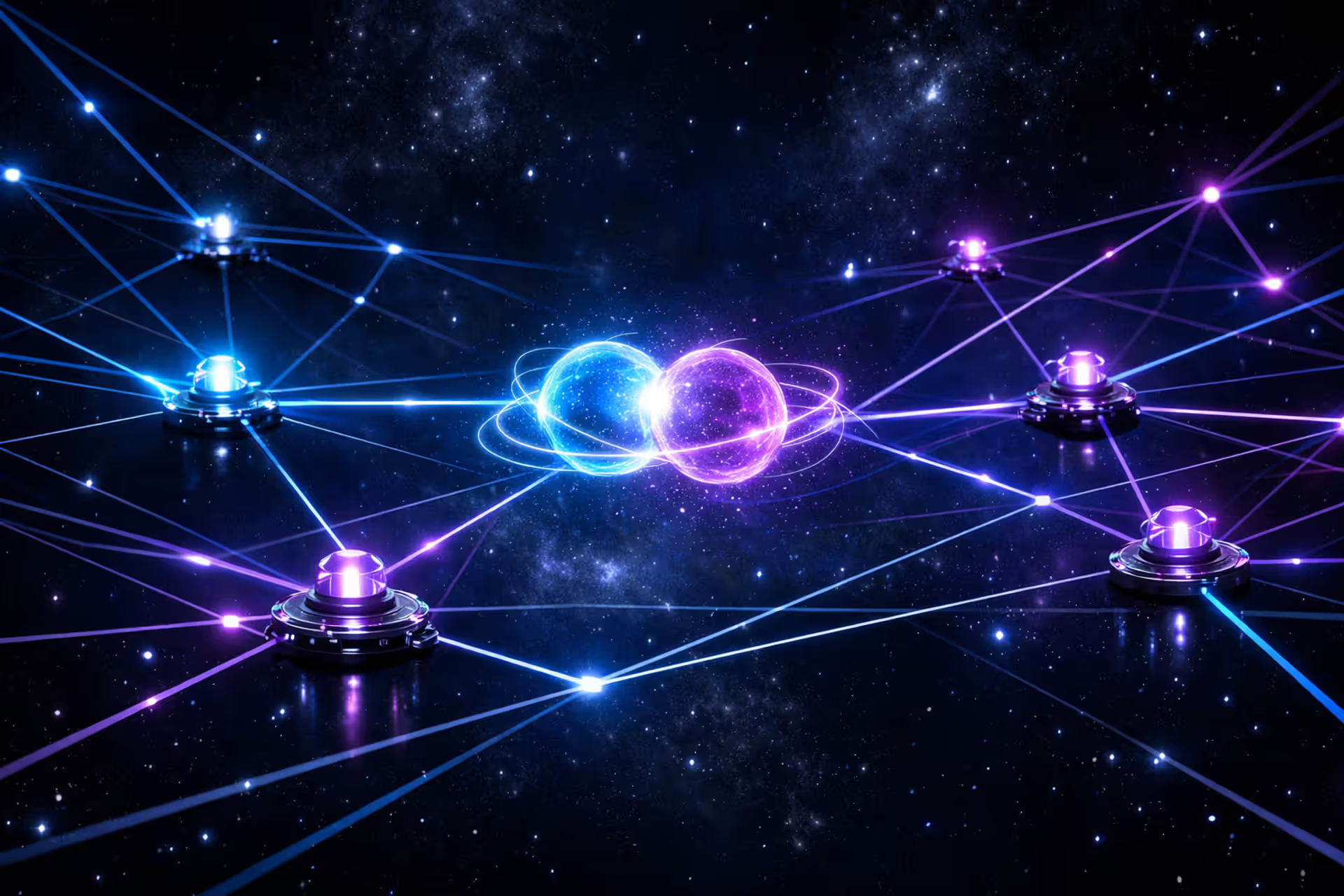
Futuristic quantum internet network with glowing blue and purple connections between nodes and entangled particles in dark space
What Is Quantum Internet and How It Works

Content
The internet you use right now—whether streaming video, checking email, or reading this article—relies on classical bits of information traveling through fiber optic cables and wireless signals. Quantum internet represents a fundamentally different approach, one that harnesses the strange properties of quantum mechanics to create networks that operate by entirely different rules.
Unlike incremental improvements like faster fiber optics or better compression algorithms, quantum internet isn't about making current networks faster. It's about building parallel infrastructure that solves problems classical networks simply cannot address, particularly in security and certain specialized computing tasks. Understanding what quantum internet actually is—and what it isn't—requires looking past the hype to examine the real science and engineering challenges involved.
The Core Concept: Quantum Internet Meaning and Foundation
Quantum internet meaning centers on networks that transmit quantum states between nodes rather than classical bits. Your current internet converts everything—text, images, video—into ones and zeros, then pushes those bits through cables at light speed. Quantum networks instead share quantum bits (qubits) that can exist in superposition, meaning they represent multiple states simultaneously until measured.
The distinction matters because quantum states carry information in fundamentally different ways. When you send a classical bit, you're essentially flipping switches on and off. When you share a quantum state, you're distributing particles that remain connected through quantum entanglement, a phenomenon Einstein famously called "spooky action at a distance."
Scientists pursue quantum networking for three primary reasons. First, quantum key distribution offers provably secure communication—any eavesdropping attempt disrupts the quantum states, immediately alerting both parties. Second, linking quantum computers through quantum networks would enable distributed quantum computing, allowing multiple quantum processors to work on problems too large for single machines. Third, quantum sensor networks could achieve measurement precision impossible with classical coordination.
The quantum internet explained in simplest terms: imagine a network where the act of observing information changes it, where particles separated by miles remain mysteriously connected, and where certain types of information become physically impossible to intercept without detection. This isn't science fiction—it's quantum mechanics applied to networking.
How Quantum Entanglement Makes Communication Possible
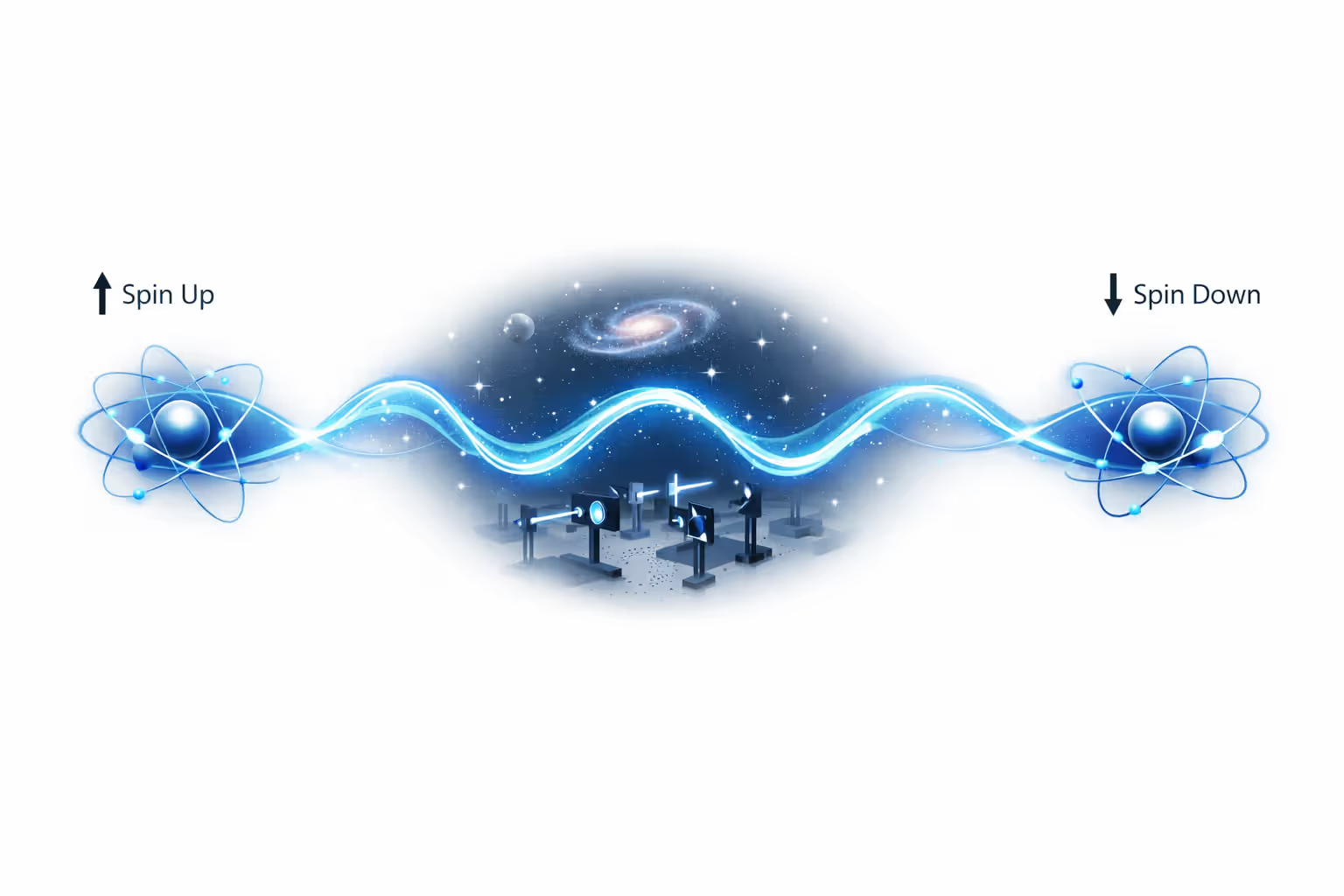
Quantum entanglement occurs when two particles become correlated in ways that persist regardless of distance. Measure one entangled particle and you instantly know something about its partner, even if that partner is across the room or across the country. This correlation forms the backbone of quantum entanglement communication.
Here's a concrete example: imagine two particles entangled so their spins are always opposite. When you measure the first particle and find it spinning "up," you immediately know its partner spins "down." The measurement of one particle appears to instantly affect the state of the other, but—and this trips up many people—you cannot use this to send information faster than light.
Author: Marcus Leland;
Source: flexstarsolutions.com
The reason relates to randomness. You cannot control what result your measurement produces. Each measurement gives a random outcome, and only when you compare your results with your partner's measurements (through classical communication channels) do the correlations become apparent. You're not sending information through entanglement; you're sharing quantum randomness that becomes useful only after classical data comparison.
Quantum networks exploit entanglement differently than most people imagine. Rather than sending messages through entangled particles, networks use entanglement to establish shared quantum states between nodes. These shared states enable quantum key distribution and quantum teleportation—a process where quantum information transfers between locations using entanglement and classical communication together.
Common quantum internet misconceptions include believing it will enable instant messaging across any distance or replace all current internet infrastructure. Neither is accurate. Quantum networks complement rather than replace classical networks, and they still respect the speed-of-light limitation for information transfer.
| Feature | Quantum Entanglement Communication | Classical Data Transmission |
| Speed | No faster than light (requires classical channel for verification) | Light speed through fiber (~200,000 km/s) |
| Security | Theoretically unhackable (eavesdropping disrupts quantum states) | Vulnerable to interception; relies on computational encryption |
| Distance Limitations | ~100 km without repeaters (decoherence); quantum repeaters still experimental | Thousands of km with signal boosters; well-established infrastructure |
| Infrastructure Needs | Cryogenic cooling, isolated environments, specialized photon detectors | Standard routers, fiber cables, commercially available components |
| Current Status | Laboratory demonstrations and limited QKD networks operational | Global infrastructure handling exabytes daily |
| Primary Use Case | Secure key distribution, quantum computing links, precision sensing | All general internet traffic, streaming, web browsing, file transfer |
Quantum Key Distribution: The First Real-World Application
Quantum key distribution networks represent the most mature quantum networking technology deployed today. Unlike theoretical quantum internet applications still confined to laboratories, QKD systems already secure sensitive communications in multiple countries.
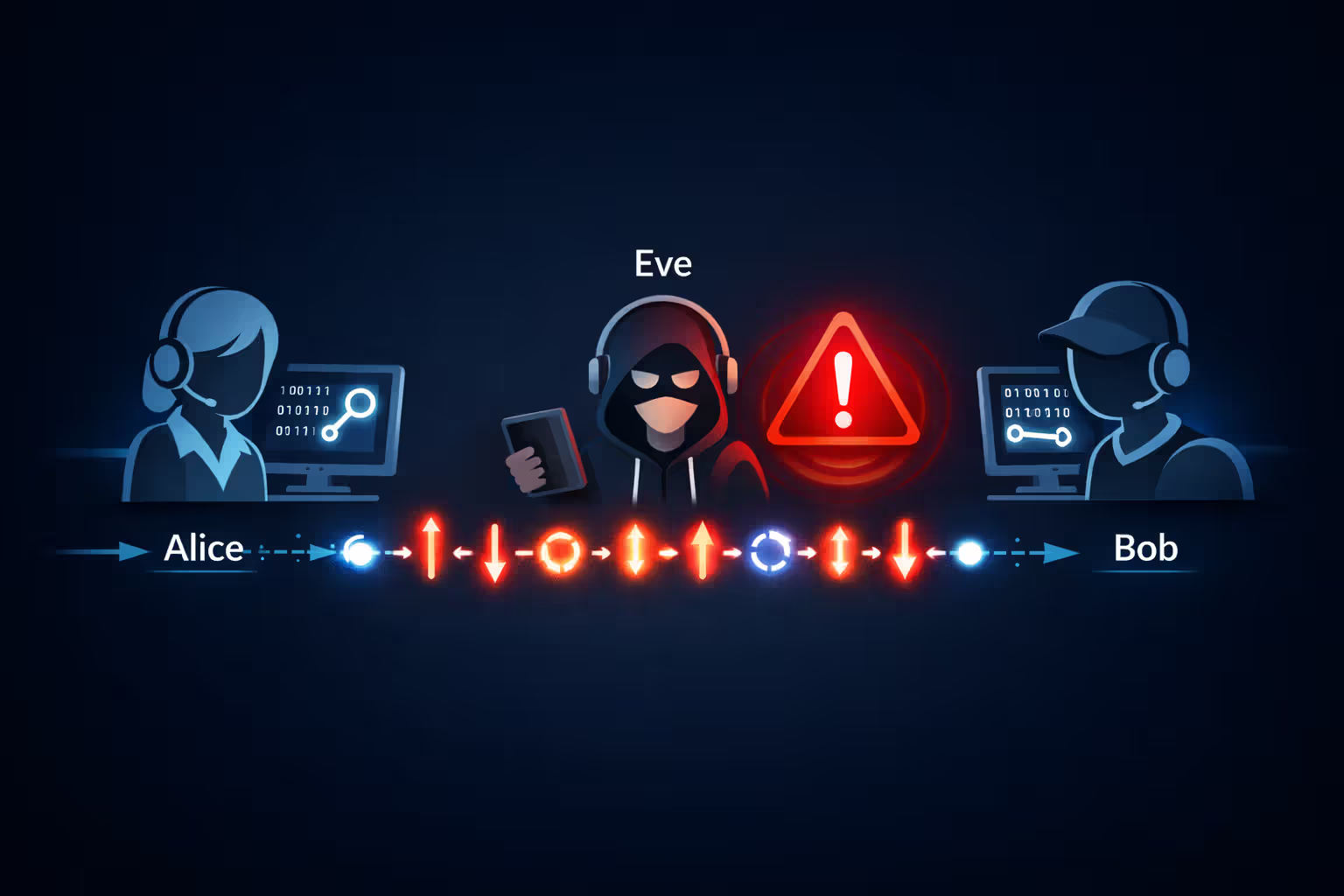
QKD works by encoding encryption keys into quantum states—typically the polarization of individual photons. Alice sends Bob a stream of photons with random polarizations. Bob measures them using randomly chosen detectors. After transmission, Alice and Bob compare their measurement choices (but not results) over a classical channel. Where their choices matched, they keep the results; where choices differed, they discard those bits. This process generates a shared random key that both parties possess.
The security comes from quantum mechanics itself. If Eve tries intercepting photons to measure them, she inevitably disturbs their quantum states. When Alice and Bob compare a sample of their key, they'll detect errors introduced by Eve's eavesdropping. They can then abort the key and try again. No mathematical problem needs to remain unsolved for security—the laws of physics provide protection.
Author: Marcus Leland;
Source: flexstarsolutions.com
China operates the world's most extensive QKD infrastructure, including the Beijing-Shanghai quantum network spanning over 2,000 kilometers with 32 nodes. The Micius satellite, launched in 2016, demonstrated quantum key distribution between ground stations separated by 1,200 kilometers. Europe's OpenQKD project connects QKD networks across multiple countries, while the United States has deployed QKD systems protecting financial data and government communications in several cities.
These networks face significant limitations. QKD requires dedicated fiber optic lines or clear line-of-sight for free-space transmission. Distance remains constrained because quantum signals cannot be amplified like classical signals—copying quantum states destroys them. Current systems max out around 100 kilometers without trusted nodes, and true quantum repeaters that could extend range remain in early research stages.
Infrastructure requirements are substantial. QKD endpoints need single-photon detectors operating at cryogenic temperatures, stable lasers producing individual photons on demand, and precise timing systems. A single QKD link can cost hundreds of thousands of dollars. For many applications, classical encryption remains more practical and cost-effective.
Five Critical Ways Quantum Internet Differs From Today's Networks
Infrastructure and hardware requirements separate quantum networks from anything in current telecommunications. Classical internet needs routers, switches, and cables—complex but mass-produced and room-temperature devices. Quantum networks require equipment that manipulates individual particles without destroying their quantum properties. That means dilution refrigerators cooling components to near absolute zero, vacuum chambers isolating qubits from environmental interference, and detectors capable of registering single photons. You cannot simply upgrade existing infrastructure; quantum networks demand parallel systems built from scratch.
Data transmission methods work on opposite principles. Classical networks copy data freely—your email exists simultaneously on your device, multiple servers, and the recipient's computer. Quantum networks cannot copy quantum states due to the no-cloning theorem, a fundamental limitation in quantum mechanics. Instead, quantum teleportation transfers quantum information by destroying it at the source and recreating it at the destination, using entanglement and classical communication. This isn't teleportation as science fiction imagines it, but it achieves something impossible classically: moving quantum information without it ever existing in the space between endpoints.
Security architecture shifts from computational to physical foundations. Today's encryption relies on mathematical problems that are difficult (but not impossible) to solve. Factor a large enough number, and you break RSA encryption. Quantum networks using QKD base security on measurement disturbing quantum states—a physical law rather than a computational assumption. However, this doesn't make quantum networks invulnerable. Implementation flaws, side-channel attacks, and trusted node compromises remain potential vulnerabilities. The quantum advantage lies in detecting eavesdropping attempts, not preventing all possible attacks.
Error correction challenges multiply in quantum systems. Classical networks use redundancy—send the same bit multiple times and take a majority vote. Quantum networks cannot duplicate unknown quantum states, making error correction vastly more complicated. Quantum error correction requires encoding one logical qubit across multiple physical qubits, with complex protocols to detect and fix errors without measuring (and thus destroying) the quantum information. Current quantum error correction techniques require dozens or hundreds of physical qubits to create one reliable logical qubit, creating massive overhead.
Scalability and distance constraints pose the toughest engineering challenges. Classical signals degrade over distance but can be amplified by reading and retransmitting bits. Quantum signals degrade through decoherence—interaction with the environment that destroys quantum properties—and cannot be amplified without measurement. Quantum repeaters, devices that could extend quantum network range, require quantum memories that store quantum states reliably for extended periods. Current quantum memories work for milliseconds at best; practical repeaters need seconds or longer. Without quantum repeaters, quantum networks remain limited to metropolitan areas or satellite-based links with their own constraints.
We're not building a faster horse; we're inventing the automobile. Quantum internet won't replace classical networks for most tasks, but it will enable entirely new applications we can barely imagine today—just as the classical internet enabled possibilities inconceivable to telegraph operators
— Dr. Stephanie Wehner
Realistic Timeline: When Will Quantum Internet Actually Arrive?
Current quantum networking exists in two stages: operational QKD networks securing specific high-value communications, and laboratory demonstrations of more advanced capabilities. The gap between these stages and a functional quantum internet spans decades, not years.
Within the next five years (2024-2029), expect expansion of QKD networks in metropolitan areas and between major cities. China will likely extend its quantum network coverage, while European and US initiatives will connect more research institutions and government facilities. Satellite-based QKD will become more common for intercontinental key distribution. These remain specialized networks serving security-critical applications, not general-purpose quantum internet.
The 10-year horizon (2029-2034) may see the first small-scale quantum networks connecting quantum computers at different institutions. These networks will enable distributed quantum computing experiments and quantum sensor arrays for scientific research. Quantum repeaters might transition from laboratory demonstrations to early field tests, though reliable long-distance quantum communication will remain challenging. Commercial QKD will become more affordable but still serve niche markets.
Looking 20 years out (2034-2044), a quantum internet backbone connecting major research centers and government facilities becomes plausible if quantum repeater technology matures. This network would support quantum computing clusters, ultra-precise scientific instruments, and secure communications for critical infrastructure. Consumer applications remain unlikely—most people won't directly access quantum networks any more than they directly access internet backbone infrastructure today.

Author: Marcus Leland;
Source: flexstarsolutions.com
Several factors could accelerate development. Breakthroughs in quantum memory technology would enable practical quantum repeaters, dramatically extending network range. Room-temperature quantum systems would slash infrastructure costs. Government investment driven by national security concerns could fund rapid deployment of QKD networks. The development of killer applications—uses so valuable they justify massive infrastructure investment—would drive commercial interest.
Conversely, delays seem equally probable. Quantum repeaters may prove far more difficult than anticipated, limiting networks to metropolitan scales indefinitely. Quantum computing progress might stall, reducing demand for quantum networking. Classical encryption might remain secure enough for most purposes, especially with post-quantum cryptographic algorithms designed to resist quantum computer attacks. The sheer cost of building parallel quantum infrastructure might not justify the limited benefits for decades.
Regional differences matter. China's centralized approach enables rapid deployment of government-funded networks but may not foster the commercial innovation needed for widespread adoption. The United States' distributed research model encourages breakthrough discoveries but struggles with coordinated infrastructure projects. Europe's collaborative framework balances these approaches but moves more slowly. Different regions will likely achieve different quantum networking capabilities at different times.
Practical Uses Beyond the Hype: What Quantum Networks Will (and Won't) Do
Unhackable financial transactions represent the most immediate practical use of quantum networks. Banks and financial institutions already test QKD systems for securing high-value transactions and protecting customer data. The quantum advantage isn't speed—classical networks handle transaction volume far better—but security. A quantum-secured financial network would detect any interception attempt instantly, making certain types of fraud physically impossible rather than merely difficult. However, implementation costs mean quantum security will protect only the most sensitive transactions for the foreseeable future.
Secure government and military communications drive much of the current quantum networking investment. When adversaries might record encrypted communications now and decrypt them later with quantum computers, QKD offers protection immune to future computational advances. Military command and control, diplomatic communications, and intelligence sharing benefit from quantum-secured channels. Yet even here, practical considerations limit deployment. Quantum networks require infrastructure that's difficult to deploy in mobile or remote scenarios. Hybrid approaches combining QKD for key distribution with classical encrypted channels for data transmission seem more realistic than pure quantum networks.
Enhanced scientific research coordination becomes possible when quantum networks link quantum computers and quantum sensors. A quantum computer in California could work on one part of a problem while a quantum computer in Massachusetts handles another part, sharing quantum states directly rather than converting everything to classical data. Quantum sensor networks could achieve unprecedented precision by sharing entangled particles across multiple measurement sites, enabling applications from gravitational wave detection to navigation systems that don't rely on GPS satellites.
Quantum sensor networks for fundamental physics research could detect phenomena too subtle for classical coordination. Arrays of atomic clocks connected by quantum networks might detect gravitational waves or test relativity with new precision. Distributed quantum sensors could map Earth's magnetic field or detect underground structures with accuracy impossible using classical coordination.
What quantum internet won't replace matters as much as what it will enable. Your everyday browsing, streaming video, social media, and email don't benefit from quantum networking. Classical networks handle these tasks efficiently and cheaply. Quantum networks add complexity, cost, and limitations that make no sense for general internet traffic. Think of quantum internet as specialized infrastructure serving specific high-value applications, similar to how dedicated financial networks handle banking transactions separately from general internet traffic.
Author: Marcus Leland;
Source: flexstarsolutions.com
Addressing common quantum internet misconceptions:
- Myth: Quantum internet will make everything instant. Reality: Quantum networks still respect the speed-of-light limit; they offer security advantages, not speed improvements.
- Myth: Quantum internet will replace all current networks. Reality: Quantum networks complement classical networks for specialized applications; most internet traffic will remain classical indefinitely.
- Myth: You'll need to upgrade your home router for quantum internet. Reality: Consumer devices won't connect directly to quantum networks; any quantum networking benefits will be invisible backend infrastructure.
- Myth: Quantum internet is just marketing hype with no real technology. Reality: QKD networks already operate in multiple countries; the technology is real but limited in scope and application.
FAQ: Your Quantum Internet Questions Answered
Quantum internet represents genuine scientific and engineering progress toward networks with capabilities impossible using classical physics. QKD networks already secure sensitive communications in multiple countries, proving the technology works outside laboratories. Yet the gap between current systems and the quantum internet of popular imagination remains vast.
The most likely future involves hybrid networks where quantum and classical systems work together. Quantum key distribution protects the most sensitive communications. Classical networks handle everything else. Quantum links connect quantum computers for specialized computing tasks. Classical internet continues serving billions of users for everyday applications.
Understanding quantum internet requires separating realistic near-term applications from speculative long-term possibilities. QKD networks will expand gradually, securing financial transactions and government communications. Quantum computer networking will enable distributed quantum computing as quantum computers mature. Quantum sensor networks will enhance scientific research. But quantum internet won't replace your home broadband, make your video calls instant, or revolutionize everyday internet use.
The timeline stretches across decades. Metropolitan quantum networks will grow in the next five to ten years. Long-distance quantum networks require breakthroughs in quantum repeater technology that may take twenty years or more. Consumer impact will remain indirect—better security for online banking, perhaps, or services enabled by quantum computing, but not quantum routers in your living room.
Quantum internet matters not because it will replace current networks but because it solves problems classical networks cannot. That's enough to justify continued research and gradual deployment, even if the results look nothing like the hype suggests.